


From Cortical Labs to NeurIPS: when intelligence is no longer simulated, but cultivated.
If someone told you that today there’s an Unreal Engine plugin capable of connecting living neurons grown in a lab to a 3D environment, you’d probably file it away as a sci-fi concept: a narrative gimmick, an idea for a horror videogame, a Black Mirror-style provocation. Instead, it’s a real project, presented in a context that’s anything but marginal: NeurIPS, one of the most important conferences in the world on artificial intelligence.
The project is called Assembloid Agency (2025) and was developed by Jenn Leung and Chloe Loewith. It was featured in the “Embodying AI” program, within the Creative AI Track co-led by Luba Elliott. And its description—read exactly as it is—hits like a line designed to blow up a mental boundary: an open-source system that connects living neurons grown on a brain-on-a-chip to a three-dimensional world generated with Unreal Engine.
.jpg)
We’re not talking about an AI that imitates a brain. We’re talking about the opposite: a piece of brain—or something disturbingly similar—put into communication with a digital environment.
And here the question immediately changes shape. It’s no longer “can the machine simulate life?” It becomes far more direct, and far more unsettling: can life become a peripheral of the digital?
The curiosity is simple. The implications are end-of-century.
Assembloid Agency, told well, sounds almost like a technical demo made sexier by a videogame context: neurons + Unreal Engine = wow. But the project’s real force is that, beneath the “cool” surface, it contains a conceptual reversal.
A biological system is connected to a simulated environment.
In other words: a fragment of life enters a digital world.
Pop culture has primed us for decades for this aesthetic. Cyberpunk literature is literally built on grafts, interfaces, wired bodies, and hackable brains. It’s natural to think of Blade Runner, but also of all that more naive—and oddly prophetic—sci-fi that now feels like future archaeology: The Six Million Dollar Man, Robocop, Ghost in the Shell.
But there’s a fundamental difference: we’re not watching a story here. We’re watching a prototype.
If, in the past, technology was imagined as an extension of the human—from the hammer to the computer—today we can glimpse a further, far more ambiguous step: technology as environment, and biology as hardware.
No more transistors and silicon. Neurons.
So What Exactly Is Assembloid Agency?
The phrase “neurons inside a videogame” is intentionally sensational, but it works because it delivers the essentials without softening anything. Assembloid Agency is an open-source plugin built for Unreal Engine that creates a bridge between two dimensions:
- on one side, a system of living neurons grown on a hardware substrate (brain-on-a-chip)
- on the other, a virtual 3D environment: space, coordinates, dynamics, simulated physics
The system acts as a translator. The digital environment sends signals, the neural tissue responds with electrical activity, and that activity is reinterpreted as behavior inside the virtual world.
This is not a metaphor. It’s not an installation “inspired” by biology. It’s a real communication structure: input, output, feedback.
And this is where the object stops being merely a scientific experiment and starts behaving like something more interesting: a cultural device. A question built in a lab. A kind of work that doesn’t simply ask to be seen, but exists to destabilize whoever looks at it.
Software, Hardware, Wetware: When Categories Stop Working
Asking whether a cultivated brain is “software” is technically wrong. Software is code: abstract, replicable, transferable. Neural tissue is living matter—wet, organic, fragile.
The right term has existed for decades, and it’s as effective as it is underused: wetware, biological hardware.
And yet the question remains legitimate, because what this system does looks a lot like what we attribute to software: transform input into output, generate behavior, adapt.
If an Unreal Engine plugin can dialogue with neural tissue and turn it into an agent, then we’re no longer in the realm of traditional computing. We’re in the realm of a radical hybridization: biology and the digital starting to treat each other as infrastructure.
It’s no longer just AI.
It’s something harder to name: organic computation.
Why Is This So Fascinating?
Because until yesterday the digital was a separate realm. An artificial environment. A simulation. An elsewhere.
Today, with projects like Assembloid Agency, the digital seems to mutate into something else: a place where biological matter can be inserted, stimulated, trained—perhaps even “educated.”
The key word emerging from NeurIPS is embodiment. In contemporary AI, it has become a central concept, because many researchers argue that intelligence, to truly exist, needs a body, an environment, friction with reality.
But Assembloid Agency introduces a far more disturbing variation: here, intelligence is not embodied in a robot or an avatar. It’s embodied in real biological tissue.
The body is no longer a mechanical shell. It’s flesh.
And flesh, by definition, is not neutral.
If Life Enters the Videogame, the Videogame Stops Being Entertainment
The most interesting part is this: in this scenario, the videogame is no longer entertainment. It becomes a laboratory.
A digital environment is perfect for “educating” an agent: you can control every variable, generate repeatable stimuli, design rewards, errors, obstacles. You can build a fully artificial ecosystem in which a neural system is pushed to adapt.
It’s the logic of reinforcement learning—except here you’re not training a statistical model. You’re training living tissue.
The videogame, from a space of escape, becomes a biological gym, where random elements mix with the causality of electronics and the plasticity of neurons.
And this inversion is one of the most revealing signs of contemporary culture: the digital no longer serves only to represent reality. It serves to produce new realities.
At This Point, Talking About Art Is Inevitable
Paraphrasing Baricco (“when you don’t know what it is, then it’s jazz”), you could say: when you no longer know whether something is an experiment, a prototype, or a provocation—then it’s contemporary art.
Not because of aesthetics, but because of conceptual structure.
A system in which living neurons are connected to a virtual world is a perfect provocation in the most technical sense: it destabilizes established categories. It forces us to rethink definitions we assumed were stable.
It follows the same logic that made certain twentieth-century gestures iconic.
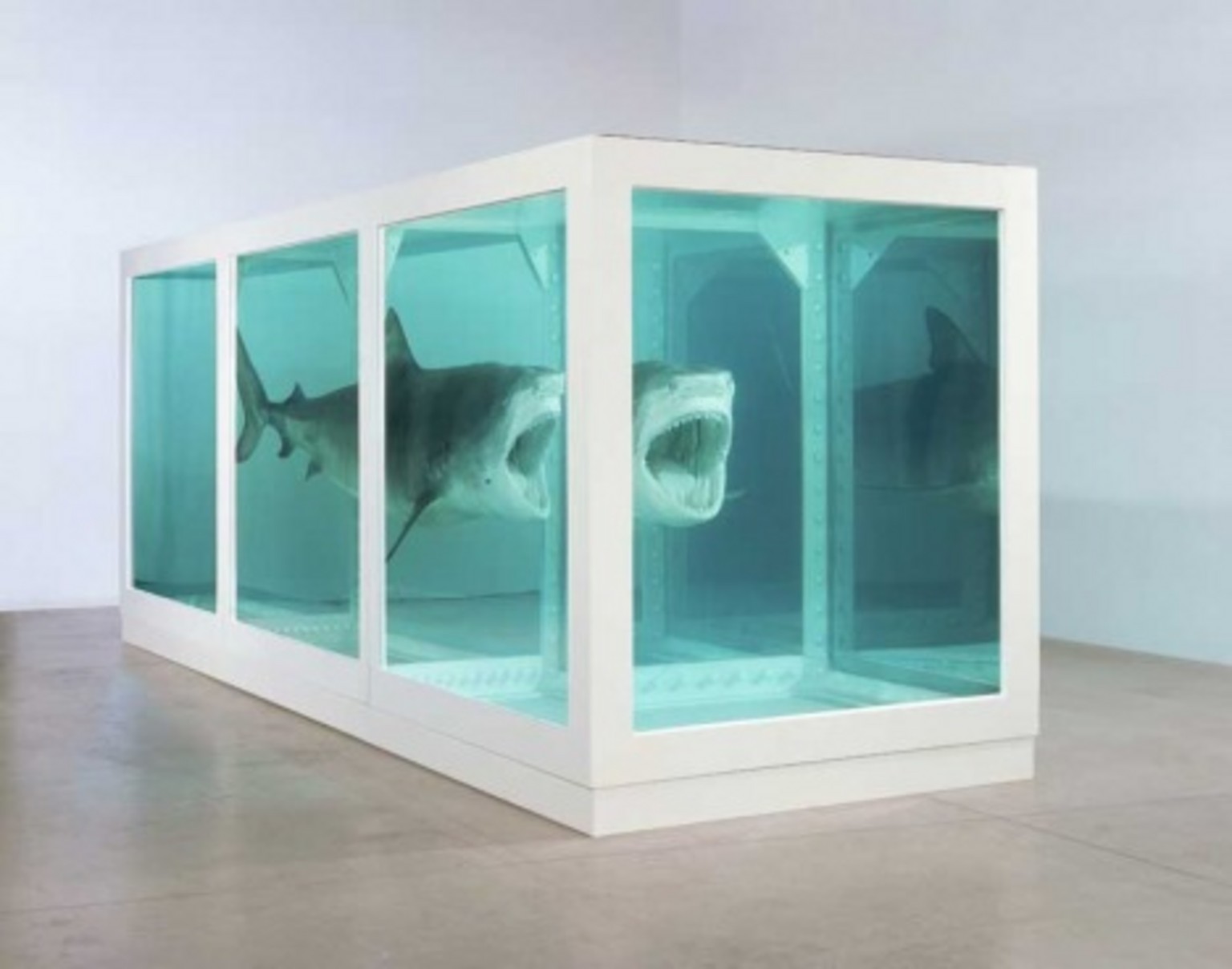
When Damien Hirst exhibits a shark in formaldehyde, he isn’t “showing a shark.” He’s turning death into an object, a scientific relic inside a museum: an act of ontological freezing.
When Joseph Beuys builds performances out of body, ritual, and symbolism, he isn’t entertaining; he’s shifting the work from object to cultural tension.
When Marina Abramović offers her body to the audience, the work becomes a psychological and social device: a human experiment without full consent.
Assembloid Agency belongs to the same family: it’s not an image, it’s a system. It’s not decoration, it’s a protocol. It’s not a finished object, it’s a conceptual machine.
And contemporary art, at its core, is exactly this: a device that produces thought.
The Artist No Longer Creates With the Hand: They Create With Infrastructure
This shift has to be stated plainly: art has moved away from manual gesture—not because technique is irrelevant, but because it’s no longer the center of the conversation.
The artist is no longer only someone who “can do it well.” More and more, they are someone who can design. Someone who can connect different languages: biology, code, aesthetics, philosophy, technology.
The artist becomes a figure closer to a director, a conceptual architect.
In the market world, Jeff Koons is the obvious example: works designed, executed by teams, industrialized. But even in more experimental art, the direction is similar: the work is often a protocol, a structure, an ecosystem.
In this sense, Assembloid Agency reads like an involuntary manifesto of a new aesthetic: the aesthetic of the system.
The Most Unsettling Part: If It Works, It Becomes Industry
Here’s the point that makes these projects more disturbing than any museum provocation.
If a shark in formaldehyde remains a conceptual relic, a brain-on-a-chip connected to a digital environment can become something else: an industrial prototype.
A biological brain consumes far less energy than a traditional computer. It’s adaptive, plastic, capable of learning. If this technology were refined, it could become a real alternative to silicon.
And then the ethical question becomes unavoidable: are we talking about components, or organisms?
Because a neuron is not a transistor. It’s a fragment of life—even if reduced, incomplete, stripped of a body.
And history teaches a very simple rule: when something becomes productive, it gets exploited.
The risk isn’t that these projects are “too artistic.”
The risk is that they’re too useful.
The Future Isn’t AI Imitating Life. It’s Life Used as AI.
For years we’ve imagined artificial intelligence as an imitation of the human mind. We built artificial neural networks, language models, algorithms capable of simulating decisions, playing chess, dominating Go, running simulated wars.
But projects like Assembloid Agency suggest a different trajectory: instead of simulating life, we may incorporate it.
It’s a radical reversal.
And if this trajectory truly develops, the future may not be a world dominated by ever more sophisticated software, but a world in which biology is cultivated, trained, integrated into digital infrastructures.
It won’t be only technology.
It will be a form of cognitive husbandry.
Conclusion: When the Experiment Becomes a Cultural Icon
Today Assembloid Agency is a fascinating, almost surreal curiosity. But it’s also something more: a perfect image of the present.
A world in which the digital is no longer merely a tool, but an environment.
And a world in which life is no longer a sacred boundary, but an integrable material.
The interesting thing isn’t only that living neurons can be connected to a virtual world. The interesting thing is that this possibility suddenly feels natural—almost inevitable. It must be done because it can be done.
And that’s the clearest sign that something has already changed.
We still don’t know whether we’re looking at a new form of art, a new form of science, or a new industrial paradigm. But we do know the question can’t be postponed:
if biology can enter the digital, who is really controlling whom?


