You’ve probably already heard that NFTs are dead—every newspaper, magazine, and news broadcast seems to be saying it in one way or another. Yet, this simply isn’t true. In fact, we are currently experiencing a very special moment in which digital technologies related to the art world are creating and envisioning truly fascinating scenarios worth observing.
It’s true that this highly disruptive and widely discussed technology, after a period of enormous hype and visibility, is now reflecting on past mistakes. The NFT art world is searching for new certainties and a renewed recognition in relation to traditional art.
It’s increasingly noticeable that a growing number of artists are seeking market validation and critical recognition by incorporating tangible, physical elements into their creative process. This raises a natural question: isn’t it paradoxical for a digital artist to also create physical objects? Perhaps it is, or more likely, only partially so.
NFTs were originally conceived as a technological means to represent digital scarcity or uniqueness, and as such, they quickly became associated with the idea of certification. Therefore, using an NFT as a digital certificate of authenticity for a physical artwork could be considered its original purpose.
From this philosophy, combined with the desire to embrace a broader and more demanding collector base—and in a traditional art world that is still somewhat reluctant to accept pure digital ownership—emerges the idea of a hybrid philosophy uniting two worlds: digital art and physical art. This is what is known as Phygital, a neologism combining physical and digital.
Early experiments were pioneering but had low adoption rates. Recently, the use of passive NFC (Near Field Communication) sensors has opened a much more compelling path for Phygital experiences in art collecting and beyond, making this approach increasingly popular.
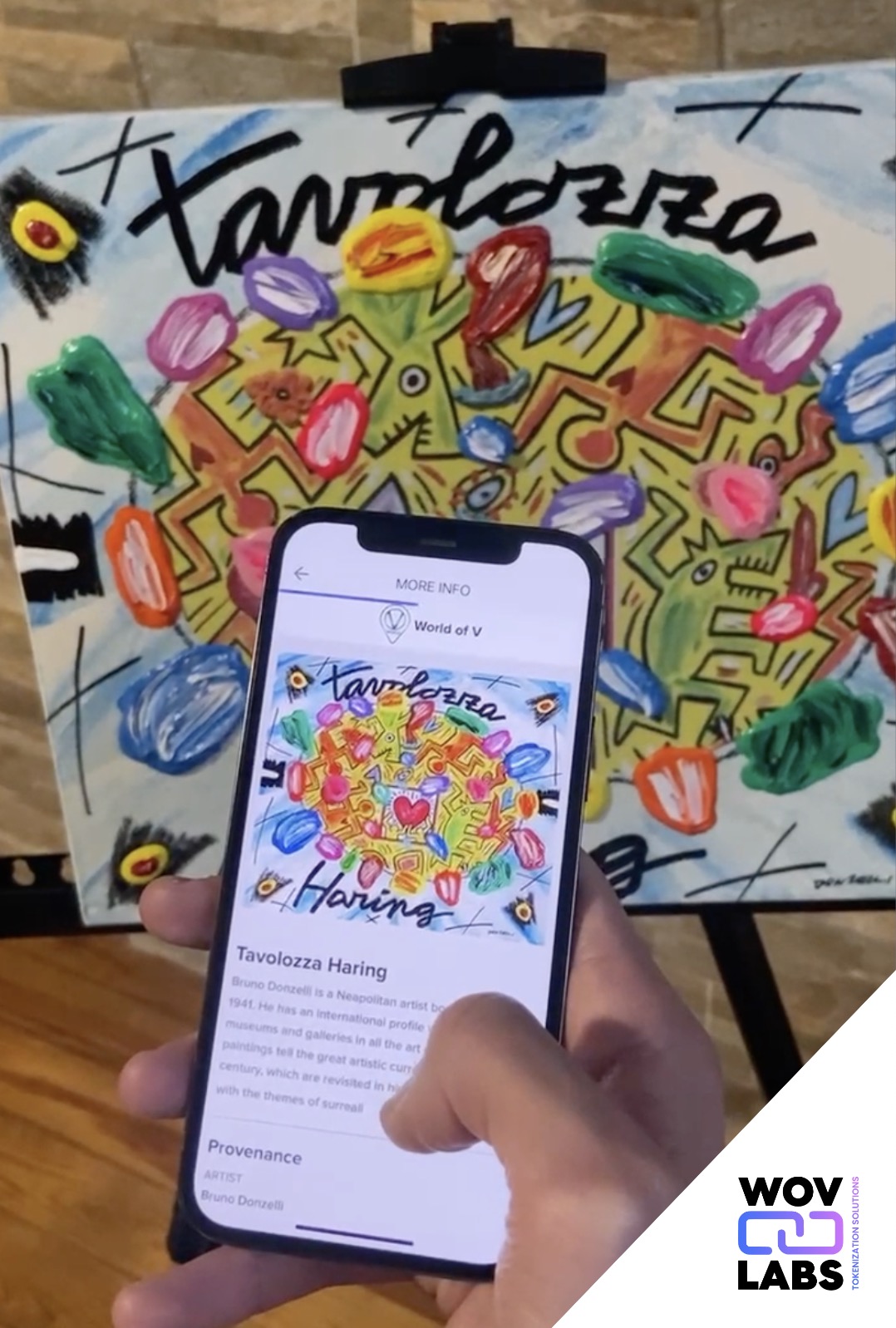
Let’s take a closer look at how it works. To illustrate the innovation in the Phygital realm, consider the experience of the Italian startup WoV Labs, a platform operating across multiple blockchains. It allows artists, creators, and brands to tokenize physical objects in a few simple steps, ensuring authenticity and provenance in a secure and immutable way.
When we talk about “tokenizing,” we refer to the process of transforming a physical object into a digital token on the blockchain, in this case, an NFT.
By integrating blockchain and IoT technology, a wide range of traditional assets—including artworks, collectibles, clothing, and food products—can be paired with a digital twin via a smart tag embedded in the object. A simple tap of a smartphone on the tag grants access to a digital passport, revealing exclusive content and securely verifying ownership of the asset.
The combination of physical and digital dimensions not only ensures authenticity and provenance but also enhances the end-user experience through an innovative, engaging, and user-friendly tool.
Here, two fundamental concepts for the art market—provenance and authenticity—come into play. These have always been central to evaluating and managing the art market, and regrettably, many challenges have arisen for artists, even prominent ones, in this area. Mismanagement of certification has often hindered optimal market development for these artists.
This technological and conceptual innovation provides an ideal solution to this long-standing issue. Imagine being able to pair comprehensive digital certification with an artist’s entire physical output. Verifying the authenticity of a painting could take just a second, while also allowing provenance and ownership history to be tracked.
Suddenly, a technology originating from a completely different sector emerges as the most logical and effective solution for managing artwork authenticity.
Moreover, those who have tested the chips produced by WoV Labs know that NFTs synchronized with tokenized physical artworks are listed directly on the World of V marketplace, where they can be sold within minutes.
Thus, there are two assets: one physical, one digital. The physical artwork and its digital, formal counterpart can both be sold, but they represent a single entity treated synchronously. Purchasing the physical artwork transfers the NFT to the buyer’s wallet; purchasing the NFT grants the right to receive the physical artwork.
This approach essentially modernizes what was previously done in a more rudimentary and inefficient way, where buying artwork was followed by manual delivery or shipping of the certificate of authenticity.
The excitement around these developments has led many artists, even those traditionally producing purely digital works, to explore physical versions of their creations—through prints, 3D printing, or advanced plotter technologies.
Ultimately, the age-old human dichotomy between being and having, between spiritual and material aspects, now manifests as the distinction between physical and digital objects. In this increasingly blended or augmented reality, the art world once again anticipates trends, offering the compelling Phygital solution.
A recent exhibition in Rome at Maison Bosi, curated by Serena Tabacchi and titled “Are You Phygital or Digital?”, explored this dual nature of artworks.
As life rapidly evolves toward ever-denser experiences, our perceptions and senses are increasingly stimulated in diverse ways. The art world, true to its pioneering spirit, presents this innovative and engaging Phygital solution.